How healthy is our posture at work? Is an hour’s jogging after a long office day enough to compensate for 10 hours of poor posture? We hear that an average of 10,000 steps a day is healthy and a good counterbalance. I thought so too.
As an ambitious runner, I fitted in a quick morning session, worked for 10 hours and then ran another hour or two before dinner. That was my routine until January 2015, when sudden lower-back pain brought me to my knees. The diagnosis was sobering: a slipped disc. No running. No seated work. Everything over?
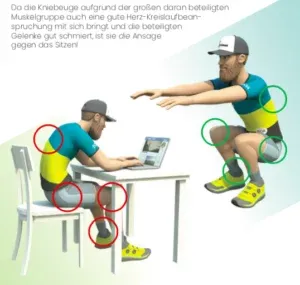
After the initial shock, I investigated the cause. Why me, when I exercised so much? Suddenly, I saw that 12–15 hours of running a week did not fit with up to 50 hours sitting at a desk. Letting my musculoskeletal system stiffen for 10 hours, then running flat out for one or two, would eventually break something. In my case, a disc. Like an old diesel engine, it protests if you demand full power before it has warmed up.
Overnight, I transformed my work and daily life. I bought specialist books, a standing desk, exercise balls and balance boards. My awareness of how work wears down the body changed. I chose to move and treat my body appropriately throughout the day. Kelly Starrett’s “Becoming a Supple Leopard” offers many useful ideas.
With these changes and regular movement breaks, things gradually improved. Using the Pomodoro Technique, I divided work into 25-minute blocks followed by five minutes of movement: 10 press-ups, 10 squats and gentle jumps. After four blocks, roughly two hours, I took a longer movement break of about 25 minutes, perhaps varied balance-board exercises or more squats.
In the following years, while preparing for the UTMB’s 170 km and 10,000 metres of climbing, I had the idea of doing 10,000 squats a month. As a lowlander with limited elevation nearby, one squat would symbolise one metre climbed. Squats are now firmly part of both my office and training routine. They have a long history with this long-bearded runner! My coach, Gerhard Schiemer, found the idea inspiring enough to write a worthwhile little book about it.
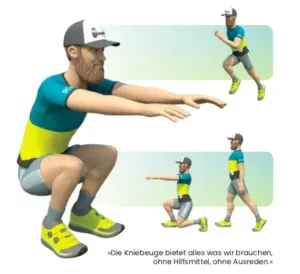
Free download: www.iruntrails.at/die-kniebeuge/
He regards squats as a universal answer to running improvement and efficient injury prevention. Hours of poor posture lead to postural problems and imbalances. Prolonged sitting or overly repetitive sport restricts mobility.
Squats strengthen and mobilise, stabilise, move and activate. They can be performed dynamically or statically in many variations.
They require no equipment and can be done anywhere, anytime, even between other activities. Even now! While reading this article, stand up briefly and do 10 squats.
Did it work? How do you feel? Tell us in a comment!
Interested in a talk?
On stage, I bring together my experiences as an entrepreneur and ultra trail runner: decisions under pressure, responsibility, and balancing performance, work and family.
Enquire about a talk